
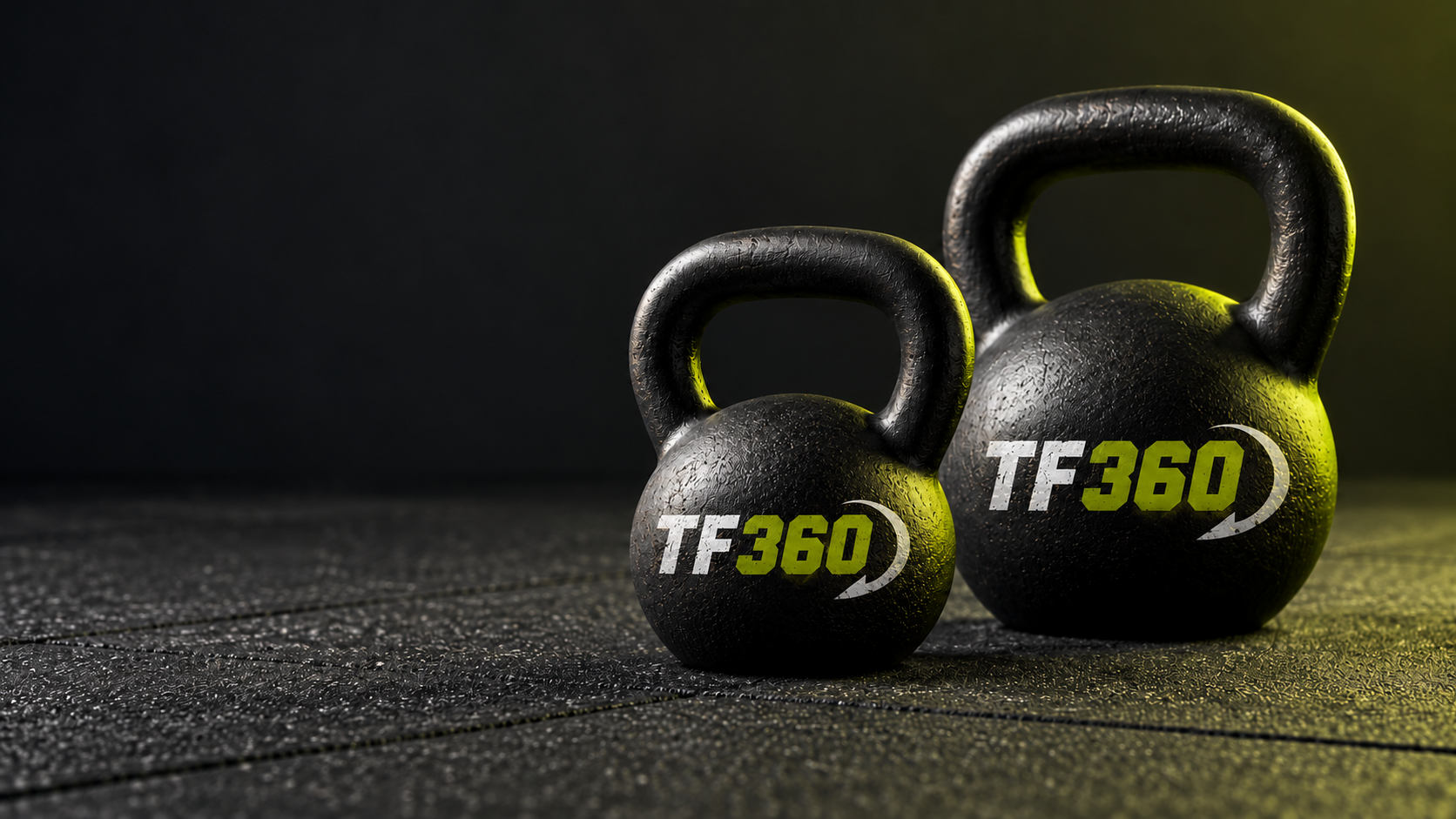
There comes a point when the kettlebell that once demanded all your attention begins to feel more familiar. You set up with greater confidence. The movement feels more controlled. You finish the planned work and wonder whether you are ready for more.
That is a useful moment to pause and assess. The next step should reflect what you can manage consistently, the exercise you are doing and the purpose of the session.
In the TF360 Method™, progressive loading means increasing the training challenge as your capacity develops. A heavier kettlebell is one way to do that. Your coach may also adjust repetitions or the amount of work you complete.
First, recognise what has already improved.
Before changing the weight, look at how you move with it. Can you repeat the exercise with the control you have been practising? Can you complete the planned work without rushing the last few repetitions? Does your technique remain consistent as the session progresses?
These observations give your coach something useful to assess. Improved movement control is progress worth recording, even when the number on your kettlebell stays the same.
In its 2026 resistance-training guidance, the American College of Sports Medicine emphasises regular participation and programmes adapted to individual goals. It also reports that training to momentary muscle failure does not consistently improve outcomes for the average healthy adult. A productive session does not require you to continue until you cannot complete another repetition. Read the ACSM guidance.
This evidence informs our approach. The following questions are TF360 coaching guidance, rather than a validated test of readiness.
Bring four observations to your coach.
- Movement: Can I maintain the intended technique throughout the planned work?
- Effort: Has the same exercise, with the same weight and workload, become more manageable across several sessions?
- Recovery: Am I arriving at sessions ready to train, taking my other activity and recovery into account?
- Purpose: What are we trying to develop in this exercise, and would more weight support that goal?
A single strong day is encouraging. A repeated pattern gives us more information. If pain is affecting a movement, pause that exercise and discuss it rather than using it to test a heavier load.
Kettlebell increments deserve attention.
Illustrative comparisons, not recommended jumps. Agree a suitable progression for each exercise with your coach.
Moving from 12 kg to 14 kg adds approximately 17% to the external load. Moving from 8 kg to 12 kg adds 50%. Both may look like the next kettlebell on the shelf, but they represent very different changes.
That is why moving up a weight is a coaching decision. You might be ready to explore a heavier kettlebell in one exercise while continuing with your existing weight in another. A weight you can manage in a deadlift may be unsuitable for an overhead press.
Your starting kettlebell is a starting point. It does not create a deadline for buying the next one.
The purpose of the session guides progression.
TF360 has four training engines because each session has a different emphasis. In Strength Flow, we work on controlled movement and progressive resistance. Endurance focuses on sustaining effort. Power asks for purposeful, energetic movement with control. Burn Lab brings these qualities together.
Adding weight changes the demands of an exercise. It needs to preserve the movement and the intention of the session. A heavier kettlebell that forces you to abandon the planned technique is a reason to reassess.
When a change is appropriate, we can agree on one manageable adjustment and observe how you respond. Keeping the other parts of the exercise consistent makes that response easier to understand.
Make your progress visible.
After training, record the exercise, kettlebell weight, planned work completed and a short note about how it felt. Something as simple as “same weight, completed the planned repetitions with better control” gives us a useful point of comparison.
For runners, include how the strength sessions fit around your runs. Bring your running workload into the conversation before increasing the challenge.
This is how we approach becoming an Everyday Athlete™: learn the movement, practise consistently and build from your own starting point.
Strong in 30 gives you a focused opportunity to begin that process. From 5 October to 3 November 2026, pay attention to what you can repeat, what is becoming more manageable and where you need guidance. Progress will differ between members; there is no requirement to reach a particular kettlebell weight by day 30.
Ready to find your starting point?
Strong in 30 is included in TF360 membership at R200 per month. Train Monday–Thursday, with 5–6 am recorded Zoom sessions or 6–7 pm live Zoom sessions, South African time.
Explore Strong in 30 or WhatsApp Ellis on 060 570 2111 to discuss your equipment and session choice.
Train Strong. Live Capable.